The whole hazard field — while there is still time to act on it.
safety of life · time-boxedwhole fields, not point readings884,736 voxels · 2.9 s
When a hazard is moving — a radiation storm, a plume, a thermal front — the people inside
it get point readings: a few dosimeters, a few gauges, each telling them what already happened
at one spot. The physics that would tell them what is about to happen everywhere —
high-fidelity transport through structure and shielding — runs hours per configuration.
Inside a warning window, that is the same as not running at all.
Flash Analyze computes the operating picture as a whole field — every location at once,
in seconds — then treats each possible response as a cloned field: branch the picture,
re-solve it per option, and take the decision with the physics already done. The picture is held by
the fleet on the fabric, and delivered even when the hazard itself has taken the comms down.
Point dosimeters report the dose you took. The field reports the dose you don't have to
take.
THE PROBLEM A solar particle event is inbound at a
surface crew — no magnetosphere, a warning measured in hours, and a shelter decision that has to
be right the first time. What the crew needs is the dose everywhere a person could be, for
every shelter option they have, before the storm peaks.
THE RESULT The full loop — threat, field,
decision, delivery — measured end to end:
The whole base, in a blink. The transport–reaction dose field through habitat,
regolith, shielding, corridors, and access ramp — 884,736 voxels, solved whole in
2.9 s, near-linear. High-fidelity Monte Carlo transport is hours per configuration;
inside a storm's warning window it cannot even start. The crew learns the shelter fails
before the storm arrives, not after.
Every decision, a cloned field — including the one that catches the trap. Six roof
options re-solved in 19 s find the lightest roof that holds (0.087 against the 0.10
crew limit), hours to spare. When the storm escalates ×2.5, the re-check is arithmetic on the
field the fleet already holds — no roof in reach survives, so the crew relocates — and
the same field reads the dose along every step of both escape routes: the convenient corridor
is a radiation duct at 4.5× the transit dose, caught before anyone walked into it.
The ceiling is published. The same engine class solves a 3.2-billion-unknown field in
≈10 minutes on one commodity desktop — where a classical direct solve needs
28 TB it cannot hold and the gold-standard method needs 64,497 years it does not
have.
Delivered through the blackout, held at every asset. The shelter plan reached all
8 fleet assets address-gated on the fabric — right key 8/8, wrong key 0/8 —
through the comms blackout the flare itself causes; and eight independent processes minted the
identical field, verdict, and route (one SHA-256), so nobody waits for orders. Composed with
Heliograph, which flags the storm hours ahead:
warning, field, decision, delivery — one loop.
A worked storm — the storm that got worse
A concrete emergency. A crew on the lunar surface — no magnetosphere — and a solar particle
event inbound. Today's playbook is a pre-designated shelter, a few dosimeters that report the dose
after it is taken, and hope. Here is the same storm with the whole field — and then the
storm gets worse.
Clock
What happened
The number
T−8h
The flag — Heliograph flags the event hours
ahead (it flagged AR 13842 before an X9.0). The crew has time — if the analysis does
fluence 1.0 at the surface
T−7h
The field — the whole base solved at once:
habitat, deep shelter, both corridors, the access ramp, every crew station. The shelter, unshielded,
reads 0.196 against the 0.10 crew limit — known before the storm, not after
884,736 voxels · 2.9 s
T−7h
The roof — six sandbag options, each a
cloned, re-solved field; the lightest roof that holds the crew under the limit, with hours to
spare; the plan address-gated to the fleet (right key 8/8, wrong key 0/8)
4 voxels · 0.087 ≤ 0.10 · 19 s
T+2h
The escalation — the event upgrades ×2.5.
Dose scales with fluence, so the re-check is arithmetic on the field the fleet already holds:
no roof in the sweep survives. The system tells the crew the truth in time: relocate to the deep
shelter (under 0.1% of the limit down there)
0.219 > 0.10 — relocate
T+2h
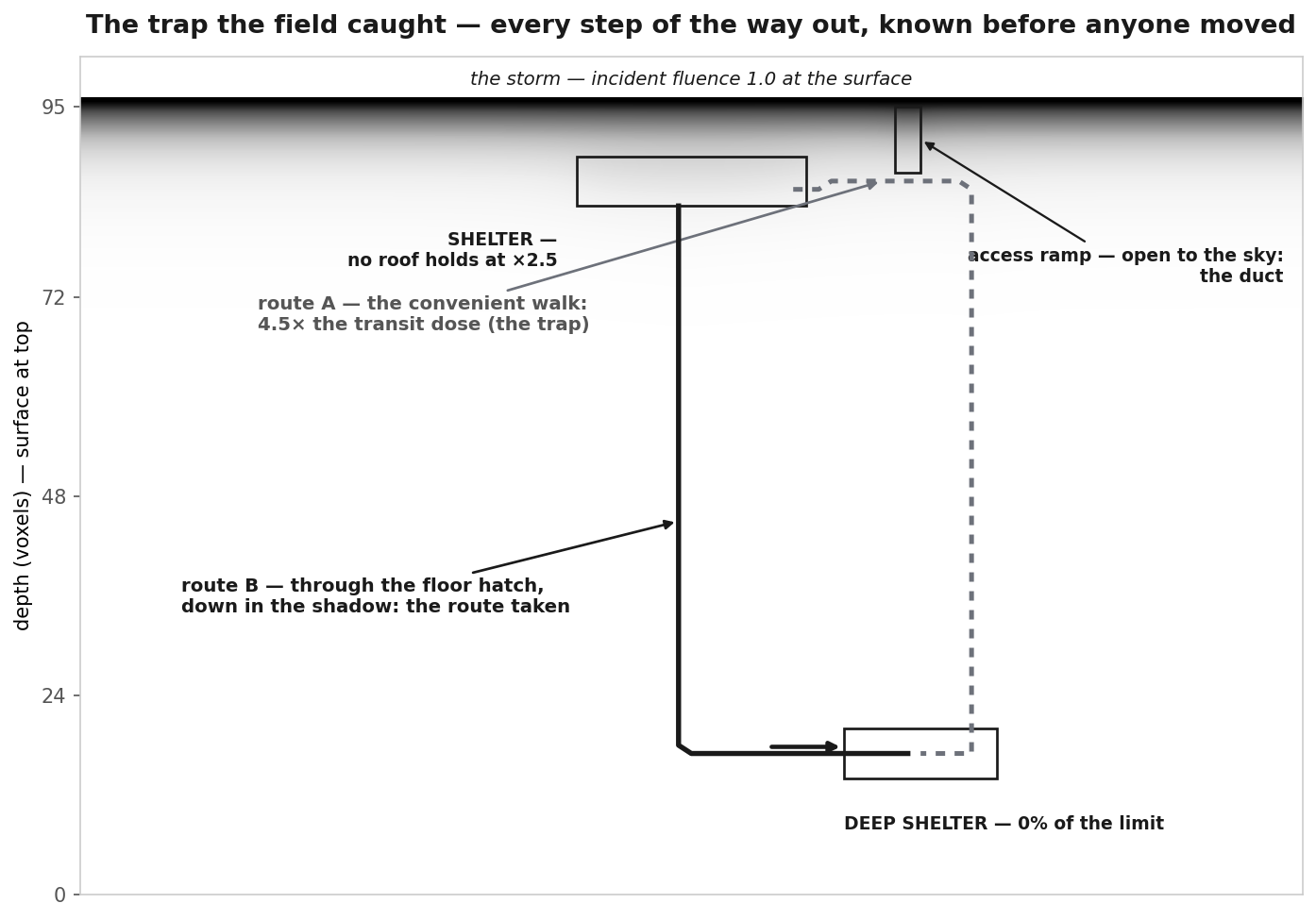
The trap — two ways down, read from the
same field: the convenient shallow walk is fed by its own sky-open access ramp — a
radiation duct; the floor-hatch route drops in shadow. A point-dosimeter plan finds this out on the
way; the field saw it before anyone moved
4.5× the transit dose — route B taken
T+2h
The proof — every fleet asset, as an independent
process, minted the identical field, verdict, and route from shared state alone. In a blackout,
nobody waits for orders: the answer is already local
8 processes · one SHA-256
The hash is 8551a24d66480610… — eight independent processes, one
answer. And the sentence that summarizes the product: the crew was never in the dark. Every dose,
every option, every step of the way out — with hours to spare.
The trap the field caught. The storm presses down from the surface; the convenient corridor
is bright because its access ramp is open to the sky — a radiation duct carrying 4.5×
the transit dose of the floor-hatch route (exposure index 2.75 vs 0.61, integrated along each
path from one solved field). Every step of the way out, known before anyone moved. Diffusion
approximation at demo grid scale; one workstation.
Storm ledger (rounded): flash_storm_solution.json
— the timeline, per-act numbers, the fleet hash. Demonstration in the diffusion approximation of
the published engine's physics; exhibits the loop that keeps a crew ahead of a storm, not a validated
dosimetry code.
Killer basic science — the same instrument, pointed at the end of time
The instrument that keeps a crew ahead of a storm answers questions physics files under
unanswerable. Here is one: a tracer is stirred by a chaotic flow and dissipated by diffusion
— a cryo tank stratifying, a contaminant in a recirculating habitat loop, a canonical
turbulent-mixing problem. After 1018 stirrings, what is the field, exactly?
And does it mix to uniform, or concentrate — forever?
Gate
What was established
The number
Exact by construction
the stirring is an exact lattice permutation: the oracle field at K=1,000 against 1,000
explicit stirring steps
byte-identical
The end of time
the exact field at K=1018 — the flow's clock folded in microseconds, the full
field in milliseconds; a float64 simulation of the same flow dies at a measured step 34
29 µs · 4.1 ms · 1016 horizons past
The stretching rate
not fitted — an exact algebraic integer: λ = (3+√5)/2 = φ², the
golden ratio squared, with the per-prime arithmetic (√5 split or inert) part of the
answer
λ = φ², exact
The verdict
the eternal fate, certified from the spectrum rather than guessed from a long run: the tracer
mixes to uniform, at this exact rate, forever
spectral gap 0.5814
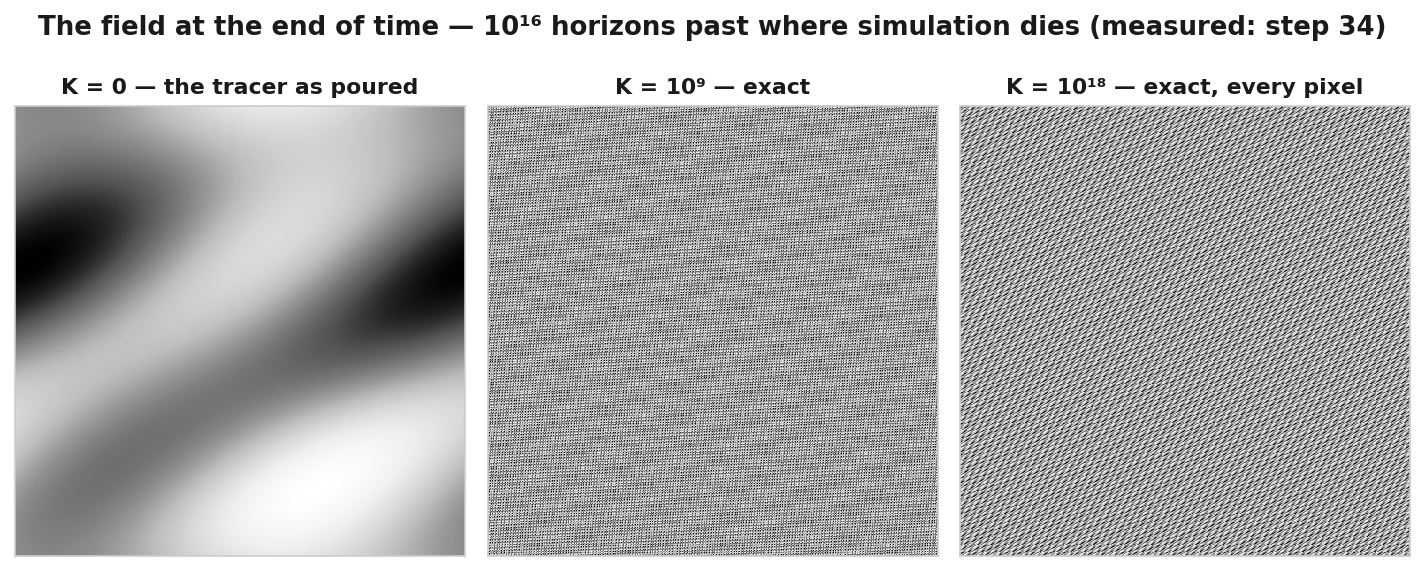
The pixels no simulation on Earth can reach. Left: the tracer as poured. Middle and right:
the exact field after 109 and 1018 stirrings — every pixel exact by
construction (the K=1,000 oracle is byte-identical to 1,000 explicit steps), computed in milliseconds,
16 orders of magnitude past the measured float64 horizon. 509² lattice; a demonstration of the
capability, not a turbulence-model validation.
The dose field and the end-of-time verdict are two askings of one instrument. Others it already
answers, each in the same style — whole answer, exact where exactness is claimed, verdict
certified:
Will this metal freeze-front solidify smooth or dendritic — and at exactly what
microstructure wavelength? The process window as exact algebraic roots, not a per-part simulation
campaign.
Does this turbulent flow's enstrophy stay capped? Regularity verdicts with every
conservation ledger held to machine zero at the operator's own right-hand side.
Can a ground telescope focus through deep turbulence? The part of the wavefront
least-squares can never see is an integer — and it is recovered, with provable loop
stability.
What reserve absorbs every coincident-demand configuration of a 60-consumer base — all
~10268 of them? Exact, in milliseconds, where sampling is blind to the rare event that
matters. (See Flash Logistics.)
What is the full probability of every outcome of a quantum computation — read from one
state, without collapse, the state kept? Published and byte-gated.
Bring the question.
How — the picture as a field, the decision as a clone
The field, not the points. The hazard is solved as one
transport–reaction field over the whole volume — every shelter, corridor, and crew station
at once — near-linear in the number of unknowns, so the whole picture arrives in seconds and can
be re-solved as the event evolves. The engine that does this is sealed; its mathematics is published.
884,736 voxels · 2.9 s · near-linear
Branch the picture. Because the field is exact, copyable data on the
fabric, every candidate action is evaluated by cloning the picture and re-solving it under
that option — six roof futures in nineteen seconds, the lightest safe one selected — and
the held field keeps answering: the escalation re-check is arithmetic, and the escape routes are read
from the same solve. A physical system cannot be copied to ask it questions; here the copy is free
and the answer is the whole field.
6 cloned fields · 19 s · the trap seen at 4.5×
Only the ceiling moves. The demonstration grid is small; the engine
class is not. Published and byte-gated: a 3.2-billion-unknown field on one commodity desktop in about
ten minutes, past a classical wall of 28 TB and 64,497 years. The same loop, at any scale the
operation needs.
3.2×10⁹ unknowns · ≈10 min · one desktop
The picture rides the fabric. The field and the plan live in shared
state — held by every asset, delivered address-gated to exactly the intended receivers, readable
by no one else, through conditions that take conventional comms down.
right key 8/8 · wrong key 0/8 · zero-traffic
And confidential — a picture only the fleet can read
An operating picture is the most sensitive thing a fleet produces: where its people are, what they are
exposed to, what they will do next. Flash Analyze holds the picture on the entanglement fabric in
the fleet's shared state: it is delivered address-gated to exactly the intended assets —
measured here at 8/8 with the right keys and 0/8 with the wrong ones — and an observer holding the
entire channel recovers noise. The keys are mintable only by executing the fabric itself; the published
barriers close the schedule from both the computational and the physical side.